
Most Families Look for Her Under the Wrong Name
Between Two Passports · No. 1 · What the Drawer Keeps: the ship’s manifest
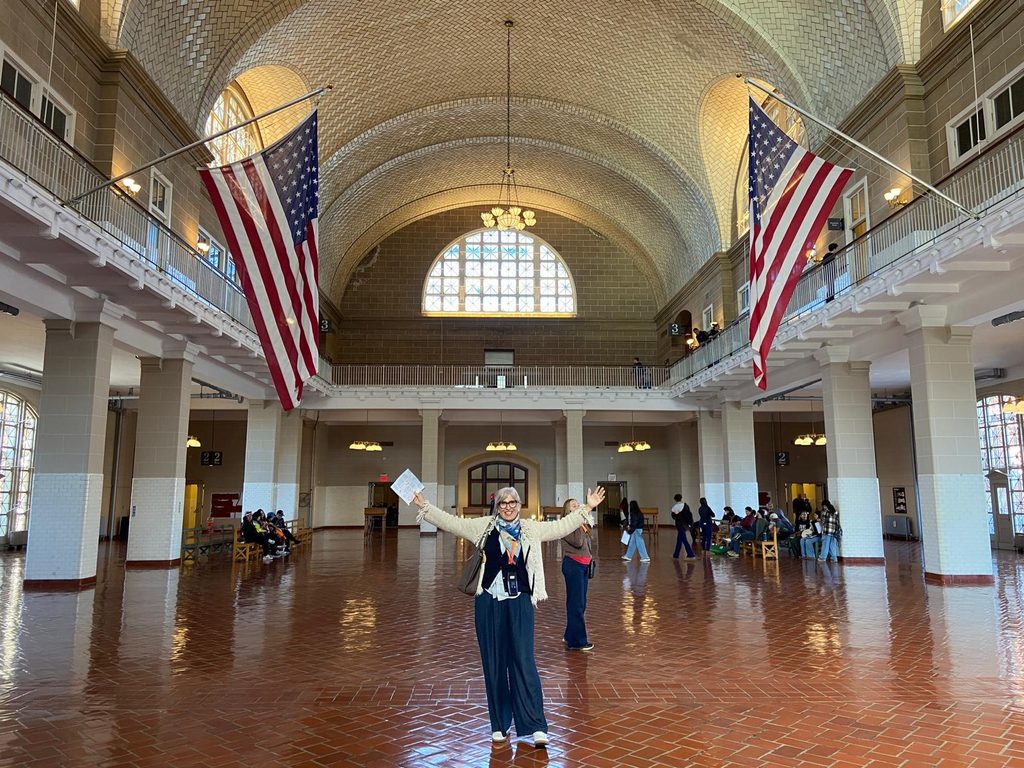
Last month I went back to Ellis Island. I climbed the stairs to the Registry Room with the rest of the morning’s visitors and, at the top, did something I had not planned: I stood in the middle of that enormous hall and opened my arms, like a woman who had just been told she might stay. I was told so myself many years ago, at a different counter and with a good deal more paperwork than a gesture. The women this hall was built to receive had a rather different experience of being admitted, and it is them I have been thinking about ever since.
Ellis Island Manifests and Maiden Names
On a reading desk near the windows, the museum keeps a card explaining how to read a ship’s manifest. It follows a couple, Giovanni Battista Simonelli and Francesca Pierdomenico, who reached New York aboard the Giuseppe Verdi on Valentine’s Day 1920, and whose descendants first looked for them on the wrong ship. Then, almost in passing, the card observes that Italian women are normally listed under their maiden names, the names on their passports, whatever their marital status.
Anyone who has searched for a great-grandmother in those ledgers will recognise the small jolt. She is there, but not where the family expects to find her: not under her husband’s name but under her father’s, the name an Italian woman keeps on every document of her life. It is the first thing I tell anyone looking for a woman on a manifest.
Women Travelling Alone
The manifest, though, was only the first page of her file. From 1903 the inspectors attached another, the Record of Detained Aliens, and it tells a story families rarely hear. The passengers held back most often were not the sick or the suspicious. They were women travelling alone. In the column headed Cause, the clerk frequently needed no more than two words: to husb.
The reasoning was administrative, and by the standards of the time it was even meant kindly. A woman could not be admitted without some assurance that someone would look after her once she left the island. In practice that meant a telegram, a letter or a prepaid railway ticket from the people expecting her, and, until it came, a bench in the detention rooms. She could not leave on the arm of a man who was not her relation. When the man was hers only by promise, the island had a remedy close at hand: an engaged woman who arrived alone was often married there and then, before she was allowed to set foot in New York.
I first met this rule not in an archive but in a novel. Luca Di Fulvio’s La gang dei sogni opens with a young mother from the Aspromonte who lands in New York in 1909, a baby in her arms and no one waiting for her. Novelists take liberties with history, but not, it turns out, with that particular detail. A Calabrian girl travelling alone with an infant was precisely the passenger the Record of Detained Aliens had been designed for.
How Long the Wait Could Last
Most such women were collected within a day or two. Some waited a great deal longer. About one arrival in ten was held for a hearing before a Board of Special Inquiry, and each board heard fifty to a hundred cases a day. It was not a court, merely a continuation of the inspection, and in roughly eight cases out of ten it ended in admission. In the end, only about two in every hundred of the twelve million who passed through the island were sent back.
Illness could stretch the wait into seasons. Josephine Garzieri, interviewed decades later for the island’s oral history programme, spent eleven months in the contagious diseases hospital on the south side of the island, undergoing painful treatment for trachoma before she was declared cured and allowed through.
The Kissing Post, and After
For everyone else, the waiting ended at the foot of the stairs. The spot where the newly admitted met the people who had come for them is still known as the Kissing Post, and I stood there too, for rather longer than was strictly necessary. It is a perfectly ordinary corner of a public building. In my experience, the ordinary corners are where the important things tend to have happened.
Nor did the waiting always end on the island. Catherine Gaetano Gallippi, who arrived from Italy in 1922 at the age of eight, told the same oral history programme that her mother tried very hard with English. She learnt to write her name and to tell the time; she never spoke it fluently. There were classes for women, Catherine remembered, but most of the mothers said they were too busy with the children. Many of those mothers spent the rest of their lives in America waiting, in a quieter sense, for a language that never quite arrived.
What to Look For in Your Family Papers
Which brings me back to the drawer. If there is a ship’s manifest in your family papers, or one you found online and printed out years ago, look for the women on it. Look for the surname nobody in the family uses any more, and for the name of the man she was travelling to. That line, in a clerk’s hurried hand, is often the only record of the days she spent on a bench, waiting for someone to come and say that she was expected.
It has a practical use as well. In a citizenship file every link in the line has to be proved on paper, and documents that disagree about a woman’s name are a frequent reason for a file to stall. The maiden name on the manifest is very often the thread that ties her American records to her Italian ones. Untangling that name is usually the first piece of work in a claim to citizenship by descent.
Bettina Holm advises on Italian dual citizenship, AIRE and the move to Italy. The first conversation, twenty minutes, is free.
First published in Between Two Passports, my weekly newsletter on LinkedIn. Subscribe on LinkedIn to receive a new issue every Tuesday.
Sources: Historic Legal Inspection, National Park Service; Registry Room, National Park Service; Ellis Island Oral Histories, National Park Service; Catherine Gaetano Gallippi, interviewed 12 December 1990, National Park Service; Reading the Record of Detained Aliens, JewishGen; Ellis Island: Where Love Crossed Oceans and Found a Home, Save Ellis Island; exhibition panels «The Ship Manifest» and «Board of Special Inquiry», Ellis Island National Museum of Immigration (seen October 2026); Luca Di Fulvio, La gang dei sogni (2008).